
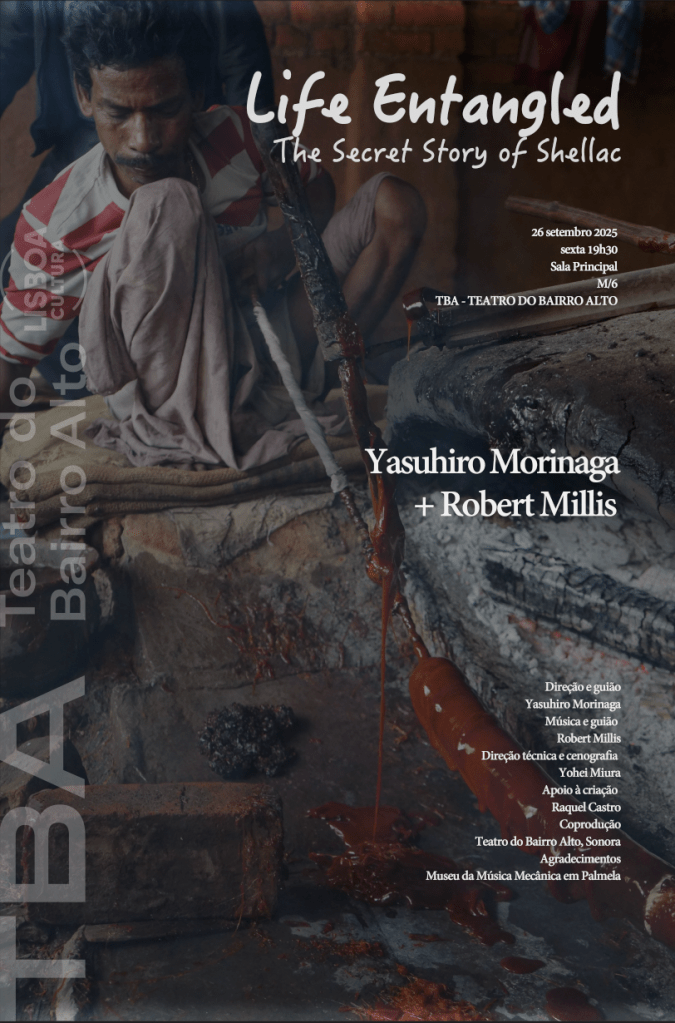
Life Entangled (The Secret Story of Shellac)
Created in collaboration with Yasuhiro Morinaga and presented as a live performance at the Teatro do Bairro Alto in Lisbon, Portugal, September 2025 and as an installation during the Lisboa Soa Sound Art festival, October, 2025 Lisbon, Portugal. To create this work we were in residence at Lisbon’s Jardins do Bombarda.
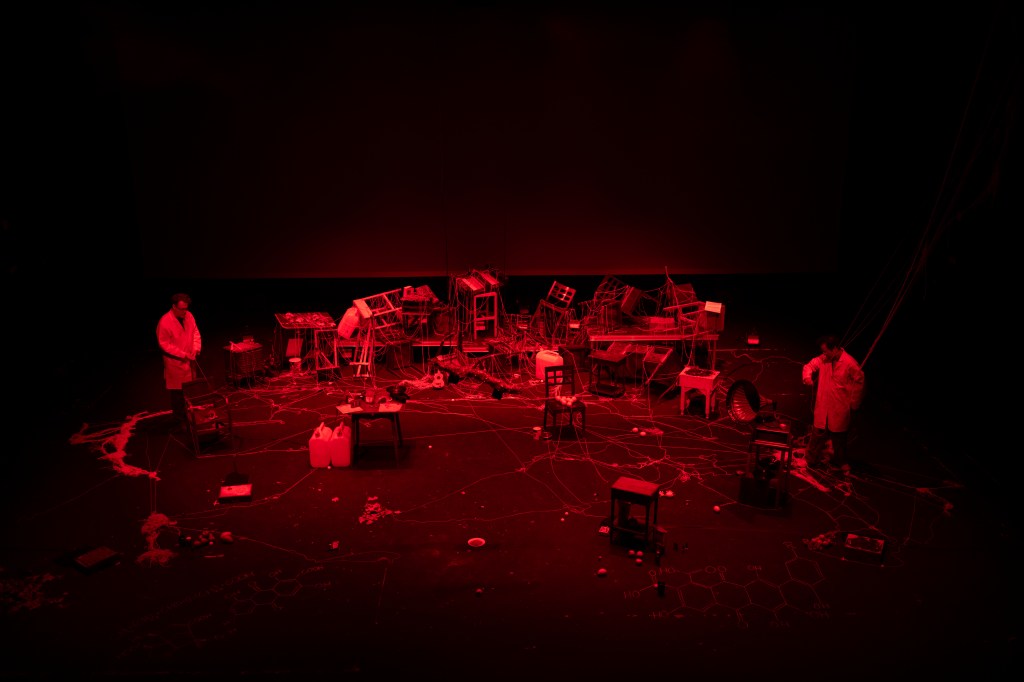
Shellac is a common ingredient. It is used in paints, adhesives, dyes, medicine, cosmetics, food and furniture finishes. It was the primary ingredient in the first music records (78rpm gramophone discs). It is used as an electrical insulator and in bombs and guns. But its history goes back 1000s of years. It comes from an insect. An extremely tiny insect called Kerria lacca or Laccifer lacca. A lac insect gets its name from the Hindi word lakh—which means 100,000. These insects swarm over the branches of trees found mostly in Asia and secrete a thick resin to protect themselves and their offspring. This resin is called lac and is the raw material used to make shellac. It covers the branches of the tree in hard reddish layers: an insect apartment complex, honeycombed with passageways for breathing, waste, and for the baby insects to escape when their time comes to swarm onto new trees. Lac resins were a hugely important export from India and SE Asia during the colonial era and helped to fuel the industrial revolution in the West. And though this natural and edible resin has partly been replaced by synthetic resins derived from petroleum, it is still important throughout the world today. Look at the ingredients of the the candy you eat. Do you see “confectioners powder”? This is shellac. How about the apples you buy—are they shiny and delicious looking? This is a shellac coating. Red dyes used in art and on fabrics and in wood are often derived from lac resins; this red color comes from a fungus that lives in the lac insects. There are layers upon layers of beings and energies that create even the simplest parts of our world, constant threads of connections, universes of entanglements. Is there a way to be respectful to these resources that exist in nature? A way to coexist? But human beings can barely coexist with each other. Nature has not “provided” such resources for us, but we take and we control and we believe we have the right to do so; however, we can not survive without a world entangled with other beings. Understanding these histories and connections is the beginning of empathy. This project gives a voice to these tiny creatures, looks at the myriad uses of shellac and imagines the red world inside the lac insect’s resin homes.

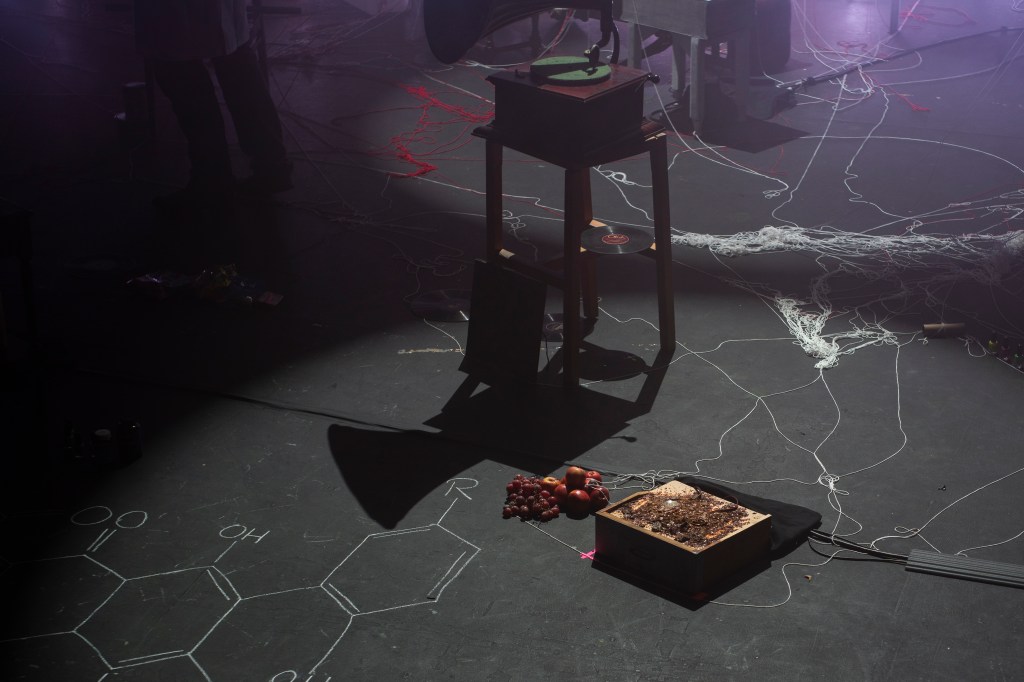
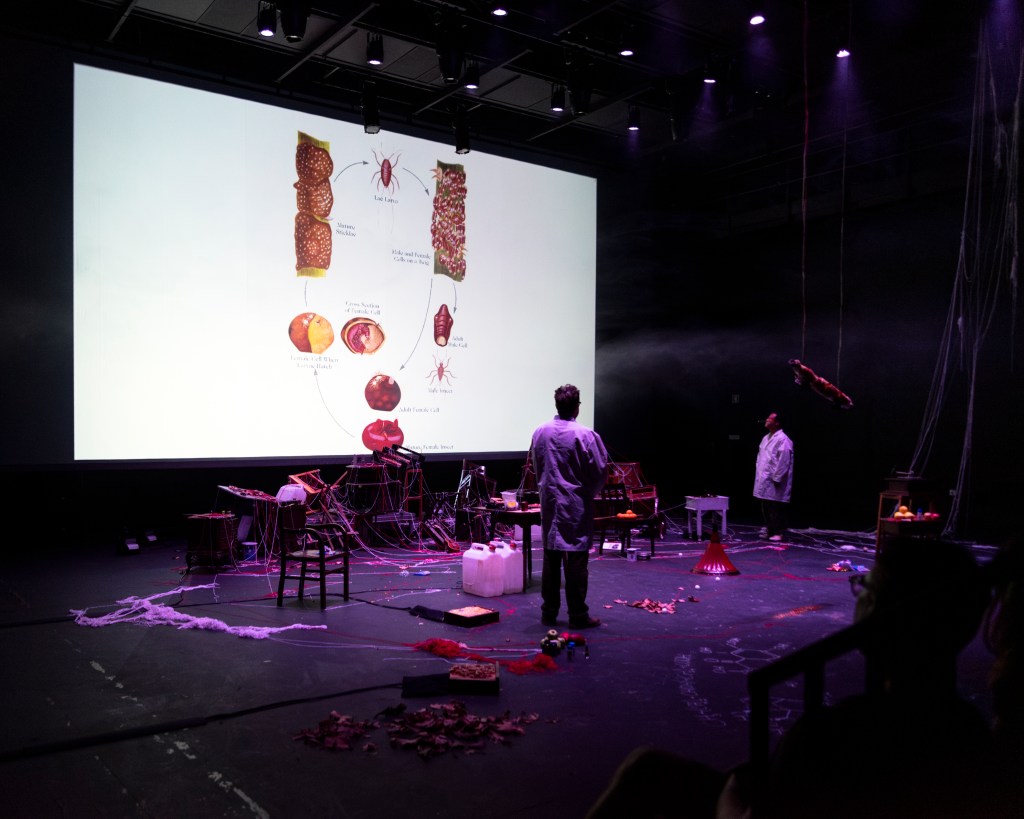
Above images are from the performance Life Entangled: The Secret Story of Shellac, presented at Teatro do Bairro Alto in Lisbon, Portugal, September 2025.
The installation version of Life Entangled was presented at the mysterious panoptico at the Jardins do Bombarda, in Lisbon October 2025 as part of Lisboa Soa.
From raw shellac the sounds of these tiny beings at work emerge, mingled with sounds from the outside world they will soon be part of as their resins are consumed by humanity. There are the sounds of the human world in the distance, the sounds of history, the sounds of electricity and warfare, the sounds of power, of the cycles of regeneration and destruction, of the metamorphosis of the world.
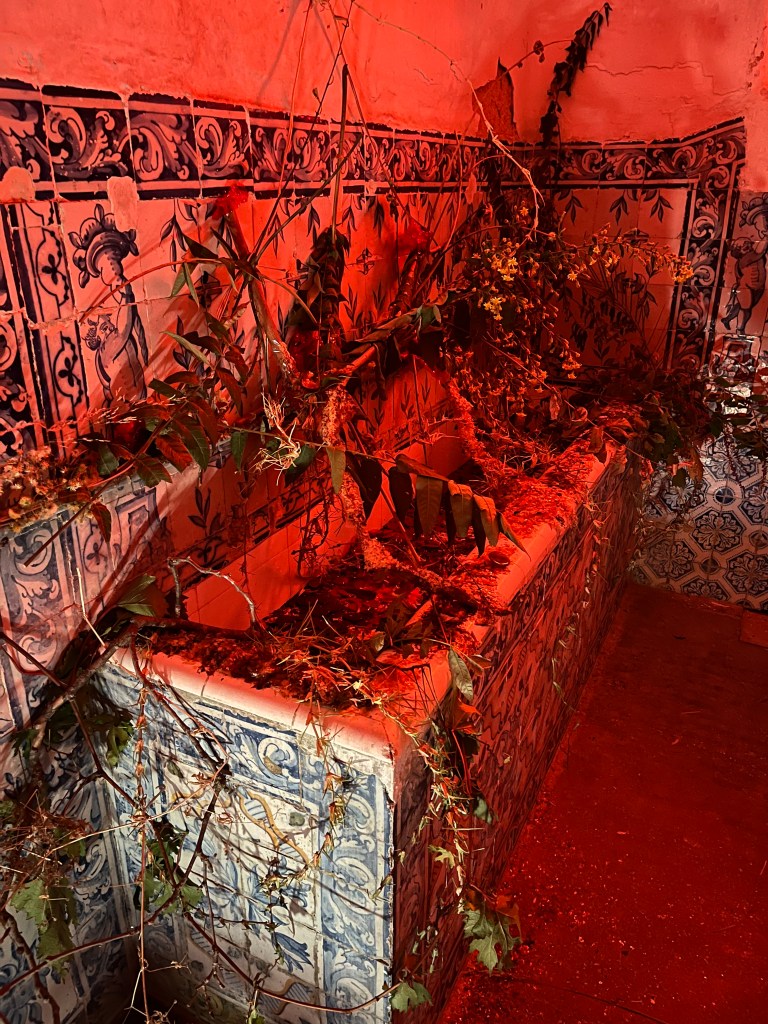
Materials: Raw shellac flakes, medallions and dust from India and SE Asia. Branches, leaves and twigs. Multi channel sound compositions created with field recordings, electronics, and 78rpm shellac gramophone records.
Voice: Claudia Efe
Life Entangled is an international collaboration between sound artists Yasuhiro Morinaga and Robert Millis, with technical and production assistance from Yohei Miura and Raquel Castro.
For more information: LISBOA SOA and Teatro do Bairro Alto

 Robert Millis